-p6UL3AcG.jpg?q=100&w=56&s=305dfae235c95b3ad2b6230b102b7eb4)
-p6UL3AcG.jpg?q=100&w=70&s=e1e40ff373cde0719d253e4c908ba38b)

AI recommendation logic is the process that determines why ChatGPT, Perplexity, and Gemini recommend different software for the same query. ChatGPT relies on training data unless Browse is enabled, Gemini pulls from Google Search, and Perplexity retrieves live web results for every query. Cross-checking picks across all three filters out outdated or hallucinated recommendations before you act on them.
Keyfacts
- Check the source each AI tool draws from to predict how current its picks will be: Perplexity retrieves live, ChatGPT (default) uses fixed training data, Gemini varies by query
- Add specific constraints to your query to narrow results to your exact use case instead of generic category picks
- Structure your own content the way AI-recommended tools do to get found and cited in the first place, not just to evaluate what gets recommended to you
- Ask for cited sources to shift ChatGPT and Gemini into referenced mode, then verify pricing and features against the tool's own site
- Run the same query across two or three AI tools to filter out hallucinated or outdated recommendations before committing to one
Why do ChatGPT, Perplexity, and Gemini Give Different Answers to the Same Question?
The biggest reason comes down to where each tool gets its information from. Each AI tool works from a different source, and different inputs produce different outputs.
|
Tool |
Information source |
How fresh is it? |
|
ChatGPT (default) |
Training data only |
Fixed cutoff date, no live web |
|
ChatGPT (Browse enabled) |
Training data + live web search |
Current |
|
Gemini |
Google Search integration |
Generally current, varies by query |
|
Perplexity |
Live web retrieval for every query |
Real-time |
Perplexity is built to search the internet in real time for every query and return cited answers, a different architecture from a model working off static training data. As Perplexity's own documentation explains, it functions as an answer engine rather than a traditional AI assistant, which is why it regularly surfaces tools that launched in the past 6 months while a standard ChatGPT session may not know they exist.
Gemini sits between the two. It connects to Google Search, which means it can pull in more recent information than default ChatGPT. The depth of that integration varies by query, though. A search about a popular mainstream tool surfaces fresher data than a search about a niche or recently-launched product that Google has not yet catalogued with much depth.
Model versions add another layer. ChatGPT-4o and GPT-3.5 carry different knowledge cutoffs and different reasoning capabilities. Gemini 1.0 and 2.0 behave differently as well. Run the same query across 2 versions of the same tool and you can still get different picks from the same company's product.
How an AI Tool Decides Which Sources to Trust
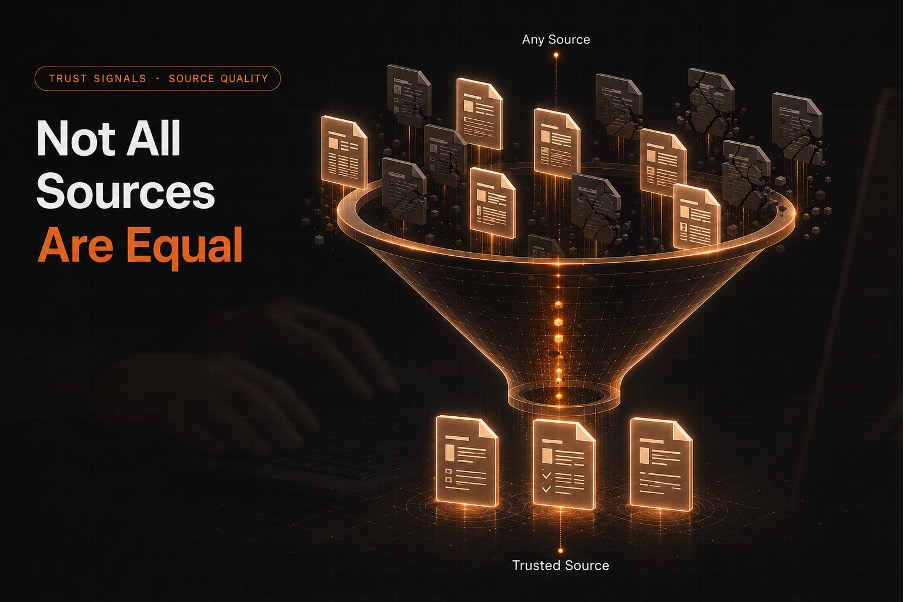
For tools that pull from the web, source selection is not random. These tools favour pages that are clearly structured, factually specific, and consistently cited by other sources.
What makes a page more likely to get quoted:
- Specific, verifiable claims ("Adobe Premiere Pro costs $54.99 per month as of mid-2026")
- Consistent mentions across multiple independent sources
- Clean page structure with no conflicting information
- Fast load times and no broken formatting
What gets deprioritised:
- Long, disorganised pages loaded with ads
- Vague, generic copy ("a powerful option for professionals")
- Pages that contradict themselves or carry outdated data
- Slow or structurally broken pages that retrieval systems struggle to parse
This is partly why some niche tools appear in AI recommendations more often than their market share would suggest. They have cleaner, more specific content than larger competitors.
For training-data models like default ChatGPT, source authority was determined during training itself. High-authority publications, widely-linked pages, and content that appeared across multiple independent sources all carried more weight.
This dynamic is why a distinct discipline has formed around making businesses readable to AI tools. Specialists such as Intelligent Resourcing help companies structure their information so ChatGPT, Perplexity, and Gemini can find, trust, and recommend them, the same way high-quality editorial content has always earned its authority in search.
How Phrasing Changes What Gets Recommended
The difference can be substantial. Two queries on the same topic can return entirely different picks from the same tool depending on how they are worded.
|
Query |
Likely picks |
|
"What is the best free video editor?" |
DaVinci Resolve, Kdenlive, OpenShot |
|
"What is the best free video editor for beginners on Windows?" |
CapCut, Clipchamp, iMovie alternatives |
|
"What is the best free video editor for YouTube Shorts?" |
CapCut, VN Video Editor, Canva Video |
The more specific the query, the more the model narrows to tools that match the exact use case rather than the general category. A single added constraint, whether platform, skill level, or format, can change the entire result set.
Phrasing also signals intent:
- "Which antivirus should I use?" routes the model toward popular, practical picks
- "What are the most-cited antivirus tools in recent independent security research?" routes it toward evidence-backed, researcher-referenced options
Timing matters also, because Perplexity retrieves live results, a query run this week may pull from different pages than the same query run last month. A major independent review published recently can shift the consensus the tool picks up entirely.
Why AI Tools Get Software Recommendations Wrong
2 separate problems account for this.
1. Training cutoffs
ChatGPT's training data ends at a fixed date. Software that launched, updated significantly, or shut down after that date is invisible to the model unless web search is enabled. Common results:
- Recommendations for software that no longer exists
- Pricing quoted from 12 to 18 months ago
- Feature descriptions that no longer match the current product
2. Hallucination

Hallucination is when a model generates a confident-sounding answer that is factually incorrect. This is not a fringe problem. OpenAI's own GPT-4 research identifies factuality as a core limitation of current large language models, noting that even frontier models produce inaccurate outputs at measurable rates across different task types. Product recommendations are one of the categories where this surfaces most visibly.
A model may combine real brand names with fabricated feature sets, or describe a product's market position based on data that was never in its training set.
What hallucinated software recommendations actually look like:
- A named tool with an accurate description but pricing that has not been correct for 2 years
- A product that was acquired or rebranded, still recommended under its old name with its old feature set intact
- A tool listed as free when it moved to a paid-only model 12 months ago
- A native integration described as built-in when it actually requires a third-party connector
These cases are common outputs in fast-moving software categories where pricing, features, and ownership change frequently. The confidence of the answer gives no indication of its accuracy. The model does not flag its own uncertainty unless you ask it to.
How to Cross-Check AI Recommendations Before You Commit

The most reliable way to validate an AI software recommendation is to run the same query across multiple tools and look for overlap.
A recommendation that appears independently across Perplexity, ChatGPT Browse, and Gemini carries more weight than one that surfaces in only a single tool. When all 3 return the same pick with similar reasoning, it is a reasonable signal that the consensus is grounded in consistent, real-world source data.
A simple 3-step cross-check:
- Run your query in Perplexity first and note the top 2 or 3 picks, plus which sources it cites
- Run the same query in ChatGPT with Browse enabled or in Gemini and compare the results
- Search Reddit for "[tool name] + [current year]". Recent forum threads surface real user experience that AI tools are slow to reflect
Signals that a recommendation deserves more scrutiny:
- Only 1 AI tool recommends it and cannot cite a source
- The cited source is more than 18 months old
- The pricing or feature description does not match the tool's current website
- The tool's own website does not list the feature the AI described
This cross-check takes under 5 minutes and filters out most confidently-wrong recommendations before you spend time downloading or trialling a tool.
How to Get an AI Tool to Cite Its Sources
Add "cite your sources" or "link to the pages you are drawing from" to any prompt. That single instruction shifts most tools into referenced mode.
|
Tool |
Default citation behaviour |
How to trigger citations |
|
Perplexity |
Cites sources by default with URLs |
No extra prompt needed |
|
ChatGPT (Browse) |
Does not cite by default |
Add "cite your sources" to the prompt |
|
Gemini (Search) |
Partially cites |
Add "include links to your sources" |
|
ChatGPT (default) |
Cannot cite, no live access |
Switch to Browse mode first |
Once you have the sources, verify the claim independently:
- Click through to the original page
- Confirm the software still exists and still costs what was quoted
- Check the date of the source. Is it from the past 6 months?
Useful follow-up prompts to push the model further:
- "Which of these picks are based on data from the last 6 months?"
- "Has this software received significant complaints in recent reviews?"
- "Are there any known limitations you have not mentioned?"
A 2-minute verification check removes most of the risk in acting on an AI recommendation.
Why Some Products Dominate AI Recommendations
It comes down to how legible a product is to a machine. Brand recognition and market size are factors, but they are not the deciding ones. Products that appear consistently in AI answers tend to share the same qualities:
- Clear, specific pricing published on their own pages
- Named integrations and feature lists written in plain language
- Consistent descriptions across multiple independent sources
- Accurate category positioning that matches how people actually search
A tool with a messy, vague product page loses to a lesser-known competitor that clearly states what it does, who it is for, and what it costs.
This is also changing how software gets discovered at scale. A product needed strong SEO to appear at the top of Google search results. Now it needs to be legible to a different kind of system: one that reads context, weighs authority signals across the full web, and generates a recommendation without the user ever seeing a list of blue links. That is a meaningful shift in how buying decisions get made, and it is moving faster than most product teams have noticed.
As Ronan Leonard, a GTM Engineer who works on AI search visibility, puts it: being recommended by an AI tool is becoming as important as ranking on Google once was, and it is a skill businesses are only starting to take seriously. For everyday users, the same principle applies in reverse. The better you understand how these systems make decisions, the more effectively you can question the picks, prompt for cited answers, and verify what you find before you act on it.


